How Can I Analyze YouTube or TikTok Videos for Mentions and Objects? (2026 Guide)
1. Why Marketing Teams Are Flying Blind With Video Content
Video is now the dominant marketing format. Brands invest heavily in YouTube creators, TikTok influencers, UGC ads, sponsored content, and long-form product reviews.
Yet despite all this spend, most teams still don’t actually know what’s happening inside the videos they pay for.
They know how a video performed — views, likes, watch time — but they don’t know how many times a product appeared, when a brand name was mentioned, or which scenes emphasized the product most.
This creates a huge blind spot.
You can see engagement metrics, but not content intelligence.
2. What Marketing Teams Actually Want to Measure
When teams talk about “video analytics,” they rarely mean charts and dashboards. They mean practical questions like:
- When exactly does our product appear in this video?
- How many times is our brand name spoken?
- Does the creator mention a competitor?
- Which scenes emphasize the product most?
- Is the sentiment positive, negative, or neutral?
These are not vanity metrics. These are accountability and performance questions.
And most existing tools don’t answer them.
3. Why YouTube and TikTok Analytics Aren’t Enough
Platforms like YouTube and TikTok are optimized for creators and advertisers. Their analytics focus on audience behavior: views, retention, likes, comments, and clicks.
What they do not do is analyze the actual content of the video.
They don’t detect objects on screen. They don’t index brand logos. They don’t transcribe speech into searchable timelines. They don’t tag timestamps where products appear or names are spoken.
They describe how people reacted. They don’t describe what the video actually contains.
4. What “AI Video Analysis” Actually Means
True video analysis isn’t magic. It’s a structured pipeline.
First, the video is ingested — either uploaded directly or linked from YouTube or TikTok.
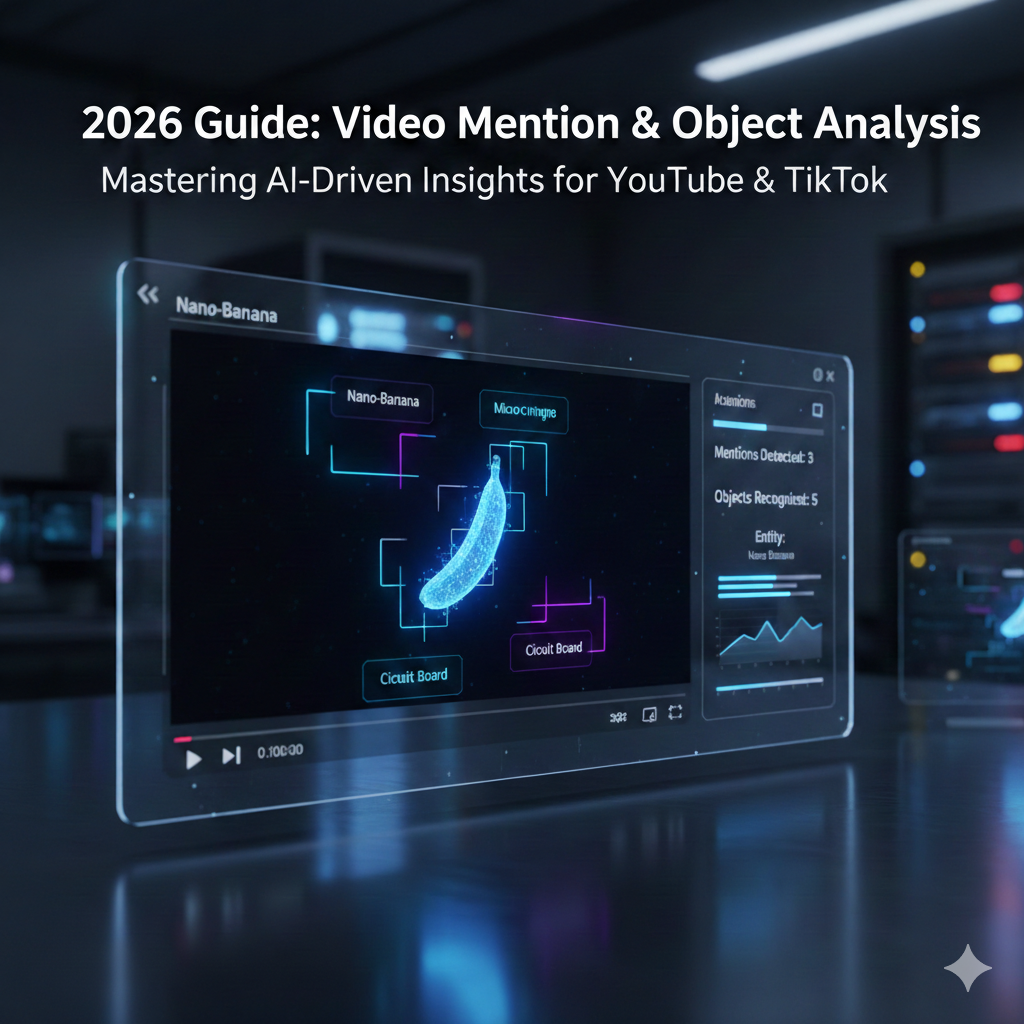
Then the system processes the visual content frame by frame, detecting objects, scenes, logos, and people.
At the same time, the audio track is transcribed into text. Keywords, entities, and contextual phrases are extracted.
Finally, all of this information is indexed into a structured timeline where every detection links to an exact timestamp.
This turns a raw video file into something that behaves like a dataset.
5. Why Manual Review Doesn’t Scale
Manual review works for one or two videos.
It collapses the moment you manage dozens of creators or long-form content.
The typical workflow today is: open the video, scrub the timeline, take notes, guess timestamps, repeat.
It’s slow. It’s inconsistent. It’s impossible to reproduce reliably.
6. How Tools Like VideoSenseAI Approach This
Modern video intelligence platforms automate this entire workflow.
For example, VideoSenseAI accepts YouTube or TikTok links, runs object detection frame by frame, transcribes speech, and builds a searchable timeline that links objects and words to timestamps.
Instead of guessing, you query. Instead of scrubbing, you filter. Instead of manual notes, you export structured insights.
The output is no longer “a video file.” It’s a searchable dataset.
7. Practical Example: Influencer Campaign Analysis
Imagine a 20-minute influencer review.
With searchable video indexing, a marketing team can:
- Detect when the product appears
- Count how many times it’s shown
- Find every spoken brand mention
- Jump directly to those timestamps
- Export a report of scenes and mentions
This transforms influencer content from creative output into measurable data.
8. Video Sentiment Analysis (The Next Layer)
Beyond detection and transcription, AI makes it possible to analyze tone and context.
Speech sentiment scoring can estimate whether mentions are positive, neutral, or negative.
Keyword clustering can show recurring themes.
This is the video equivalent of NLP sentiment analysis for tweets — except now applied to spoken content and visuals together.
9. Who Needs This Most
This workflow is especially valuable for marketing agencies, influencer platforms, brand analytics teams, PR teams, UGC advertisers, social media agencies, and market research firms.
Any team dealing with large volumes of video content will eventually need this.
10. Final Thoughts
Analyzing YouTube or TikTok videos is no longer just about views and likes.
Modern teams need to understand what appears, what is said, when it happens, and how often it happens.
AI makes this possible.
Searchable video analytics transforms raw footage into structured, queryable data.
And that unlocks a completely new layer of insight for marketing, advertising, and content intelligence.
Check this article on how VideoSenseAI wokrs: https://videosenseai.com/blogs/turn-video-into-searchable-data/
Related Guides
If you're exploring AI-powered video intelligence, you may also find these in-depth guides useful:
- What Is a Video Search Engine? How AI Turns Video Into Searchable Data
- How to Search Inside Videos for Objects, Words & Events Using AI
These resources explain how modern video indexing works and how you can turn long footage into structured, searchable data.